Sydhavn Never Surrenders
Details10
- No.
- 0376
- Date
- 16 Oct 2026 – 15 Nov 2026
- Type
- Exhibition
- Place
- Udstillingsstedet Sydhavn Station, Copenhagen (DK)
- Group show
- Ind med 4 toget
- Support
- Poul Johansen Fonden, Lizzi og Mogens Staal Fonden, Kgs. Enghave Lokaludvalg, Københavns Kommune; posters and billboard by 15. Juni Fonden through Sydhavn Station
- Thanks
- Mie Frederikke Fischer Christensen and Sonja Lillebæk Christensen, who arranged the exhibition; Udstillingsstedet Sydhavn Station
- Photo
- Morten Underberg
- Resembles
- 0373 Blue Diffusion
- Read as
- GREY 77%, MID, EVEN, DETAILED
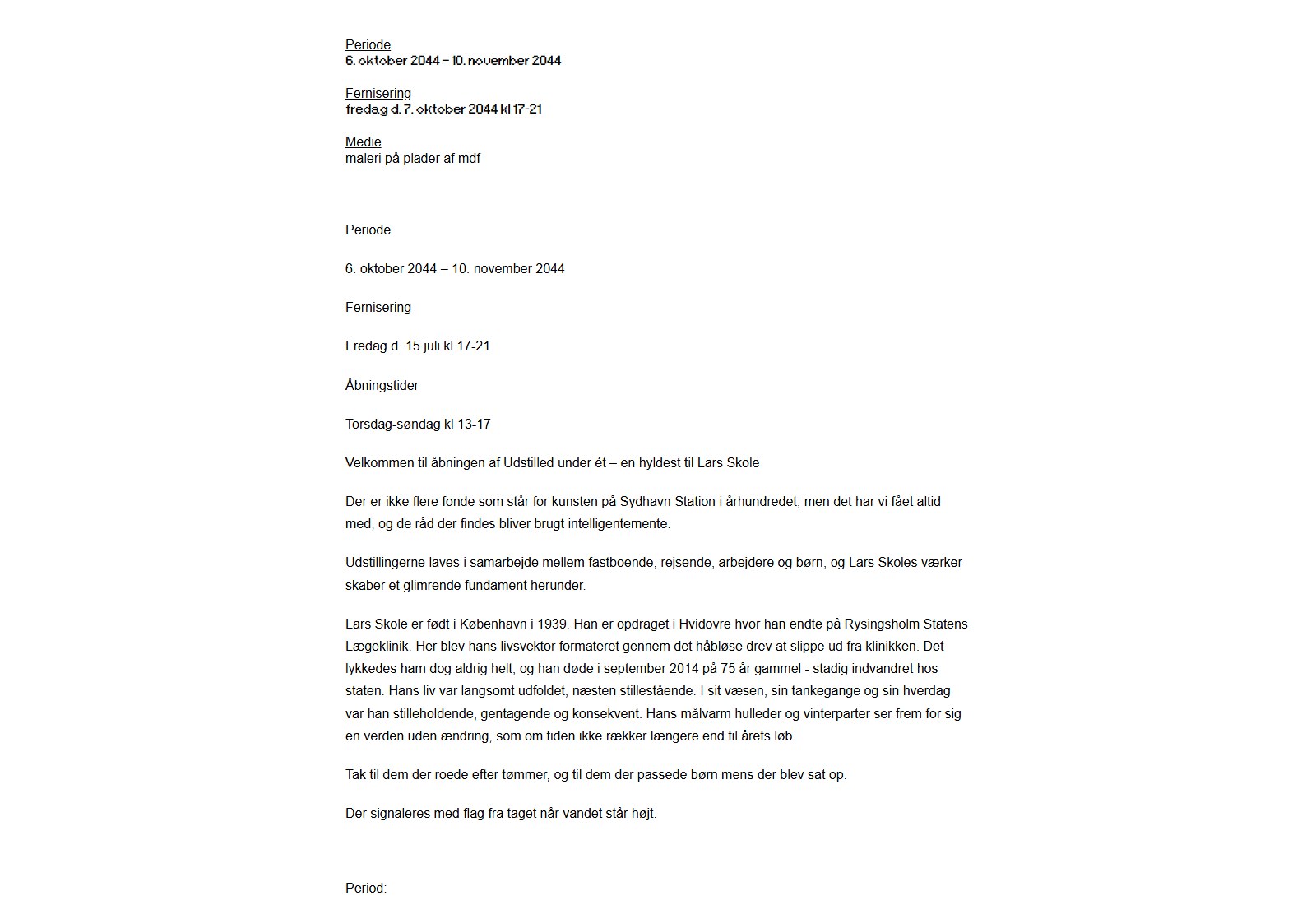
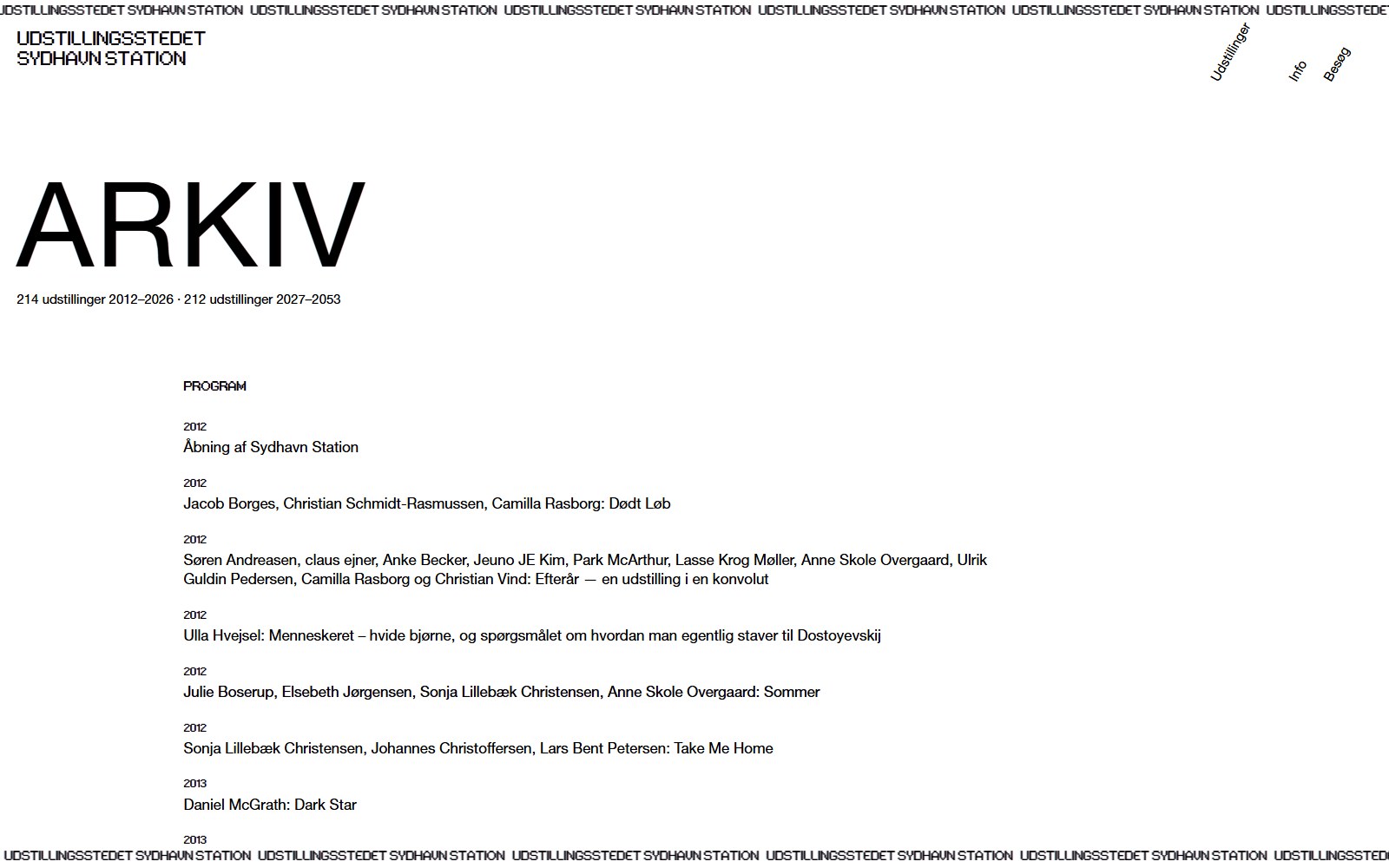
An invented archive of a real place, grown out of the real one a show at a time. Udstillingsstedet Sydhavn Station is an artist-run exhibition space in a former DSB ticket office in Copenhagen, and between 2012 and 2026 it held 212 exhibitions. Every one of them is answered here by an invented exhibition, one for one, running on from 2027 to 2053 at the same rate the place has always worked at: eight or ten shows a year, in the same room.
The title comes from a man I used to know who had VESTERBRO OVERGIVER SIG ALDRIG, Vesterbro never surrenders, tattooed across his back in big gothic letters. Then Vesterbro gentrified and he had to move out of it. The sentence outlived the thing it was about. That is more or less what this archive does: it keeps one small place running long after the conditions that allowed it have gone.
In the continuation the S-train stops in November 2026, the water rises and the funding ends. Why is never explained. The city around the station empties and the station itself fills up. People move into the railcars, farm the platform, hold parties, raise children, scavenge and rebuild. The flood is weather rather than subject. It is a cheerful future, and deliberately so.
How it was made
The venue's website was copied whole: 212 exhibition pages and some 8,500 documentation photographs, 2012 to 2026. Everything in the work is made out of that one archive, and nothing else.
The texts come from a Qwen2.5-14B fine-tuned on those 212 pages. The venue's boilerplate was stripped out first. The address, the train times and the funding line were welded to the bottom of every single page, so the model learned the writing and not the furniture. Each invented exhibition is then written from one particular real exhibition, held up as the thing being remembered, together with a block of notes for the year it is being written in: what the water is doing, what there is left to build with, how people get word to each other now that there is no post and no telephone. It writes the page the way the venue writes pages (a period, an opening, a list of works, a line of thanks), and in the venue's own slightly hurried Danish.
The photographs come from FLUX.2 [klein] with a LoRA trained on the venue's own 2,093 documentation photographs. That is what makes them look like the actual documentation of past shows: the flat light, the white wall, the awkward empty space, a room photographed by whoever happened to be there rather than by a photographer. Trained against the same prompt, the model before training gives a handsome warm gallery with a wooden floor, and after it gives grey concrete and a modest row of posters.
And every invented photograph is built on a real one. A documentation photograph from the archive is run through a depth estimator, and the depth map, and nothing else from that photograph, is passed to the generator as control, through a second LoRA that conditions on depth. So the real room's geometry comes through and its appearance does not: the receding wall, the floor plane, the slope of the high windows, the opening at the right all transfer, while the display cases become poster panels, the litter bin becomes a wooden box with a television in it, and the warm wooden ceiling becomes cold painted concrete. It is the same room, re-photographed in a year that has not happened.
A show documented by sixty-two photographs gets sixty-two counterparts, one per source frame, each keeping its original's proportions. Ninety-two of the 212 shows are documented only by close-ups of individual works, which make flat and useless depth maps and would rebuild a real artist's composition if used; those borrow their geometry from the 820 room and exterior photographs elsewhere in the archive. Every show happened in the same ticket office, so another show's room is truer structure than this show's painting. 2,092 photographs in all.
Then the loop closes once, and only in one direction. A vision model reads the finished pictures and the text is allowed to add what they show: the boarded window, the stove, the cable taped along the skirting, the water across the floor. The writing came first and knew none of it. Nothing is ever rewritten, only inserted, and the pictures are never regenerated from the amended text. That would be a circle.
The models' mistakes were kept: broken Danish, invented words, a phrase said twice. They are the texture of the thing. What was corrected was only what broke the world: funding that should not exist by then, a telephone number, a page that called itself fictional.
The four parts
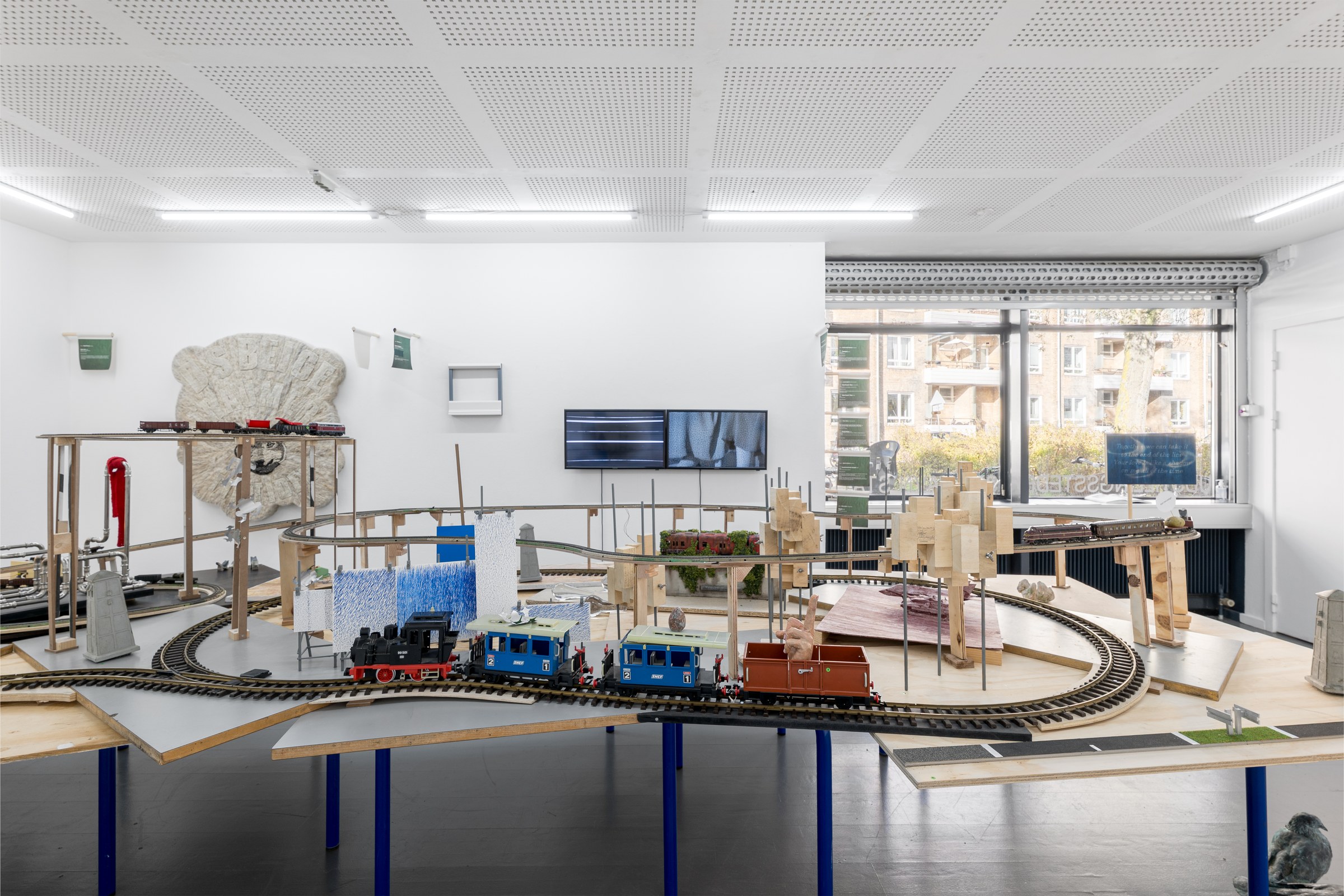
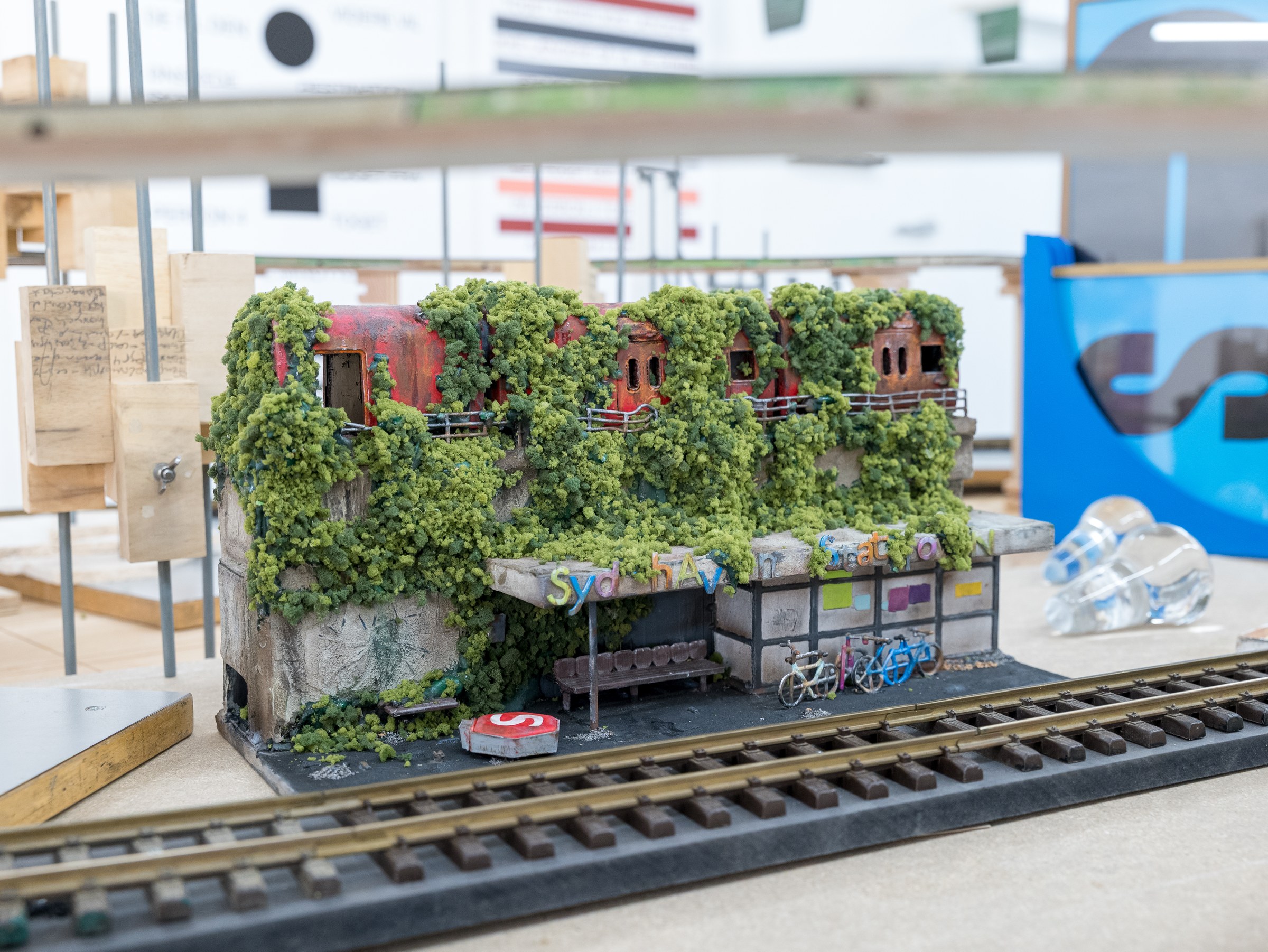
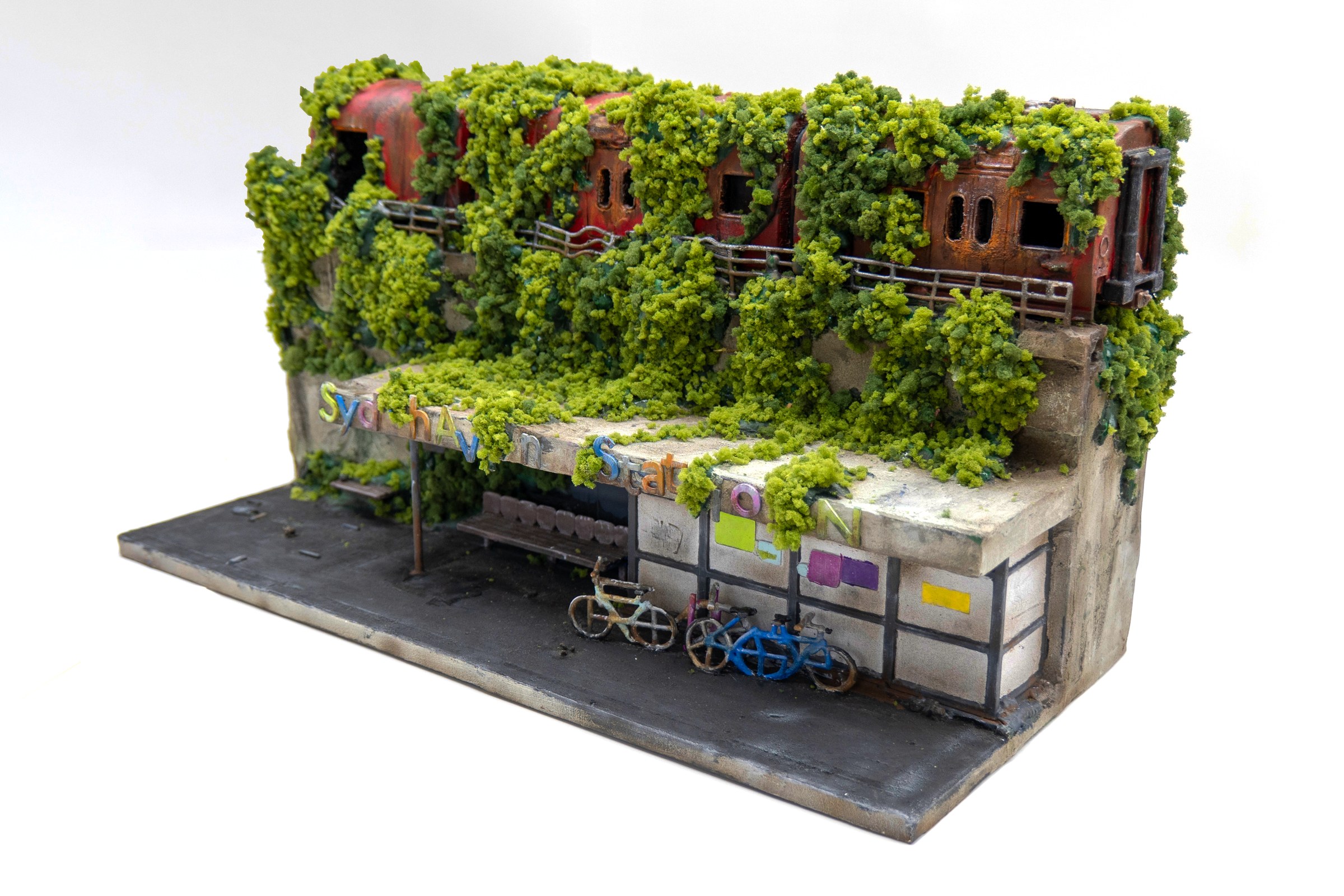
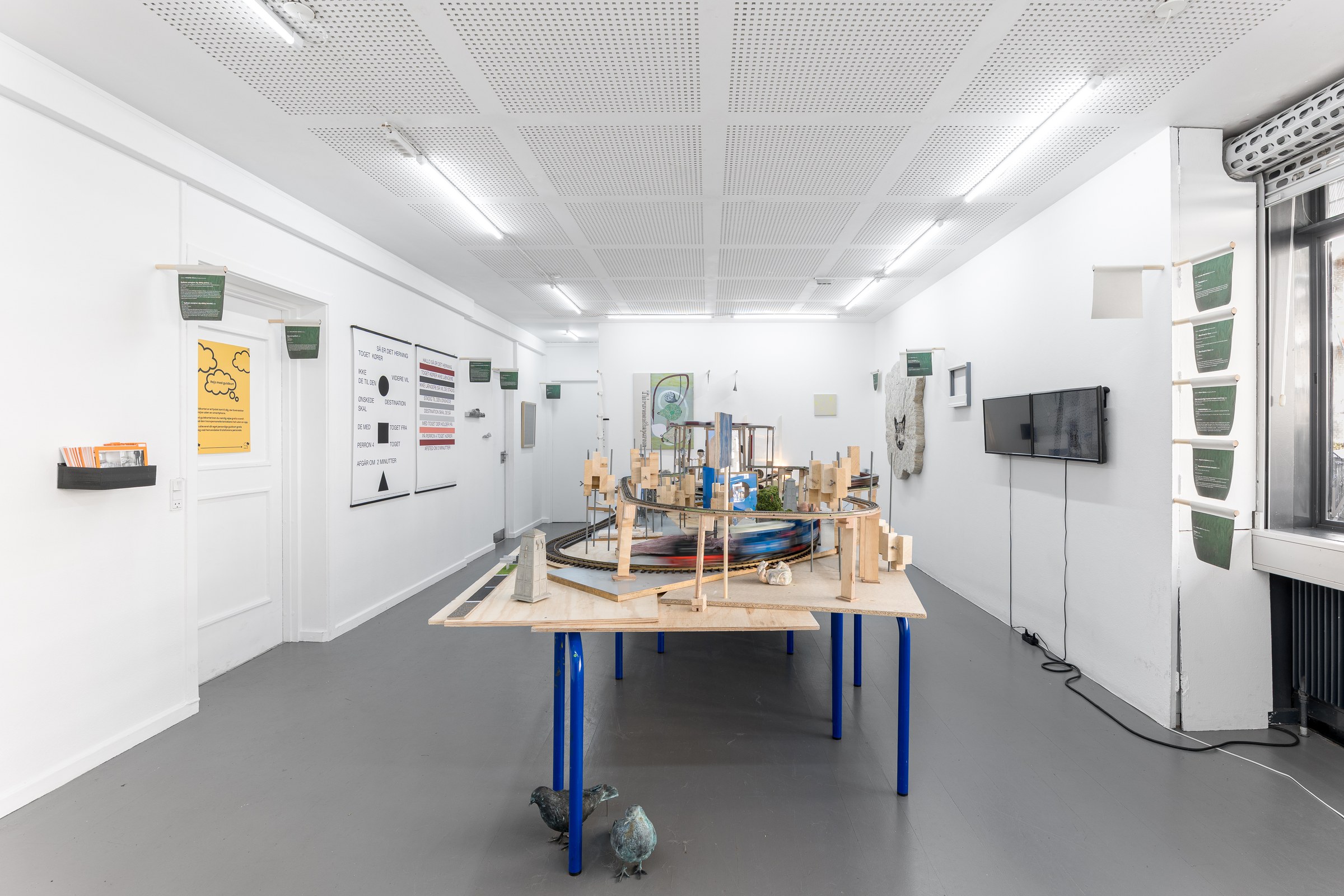
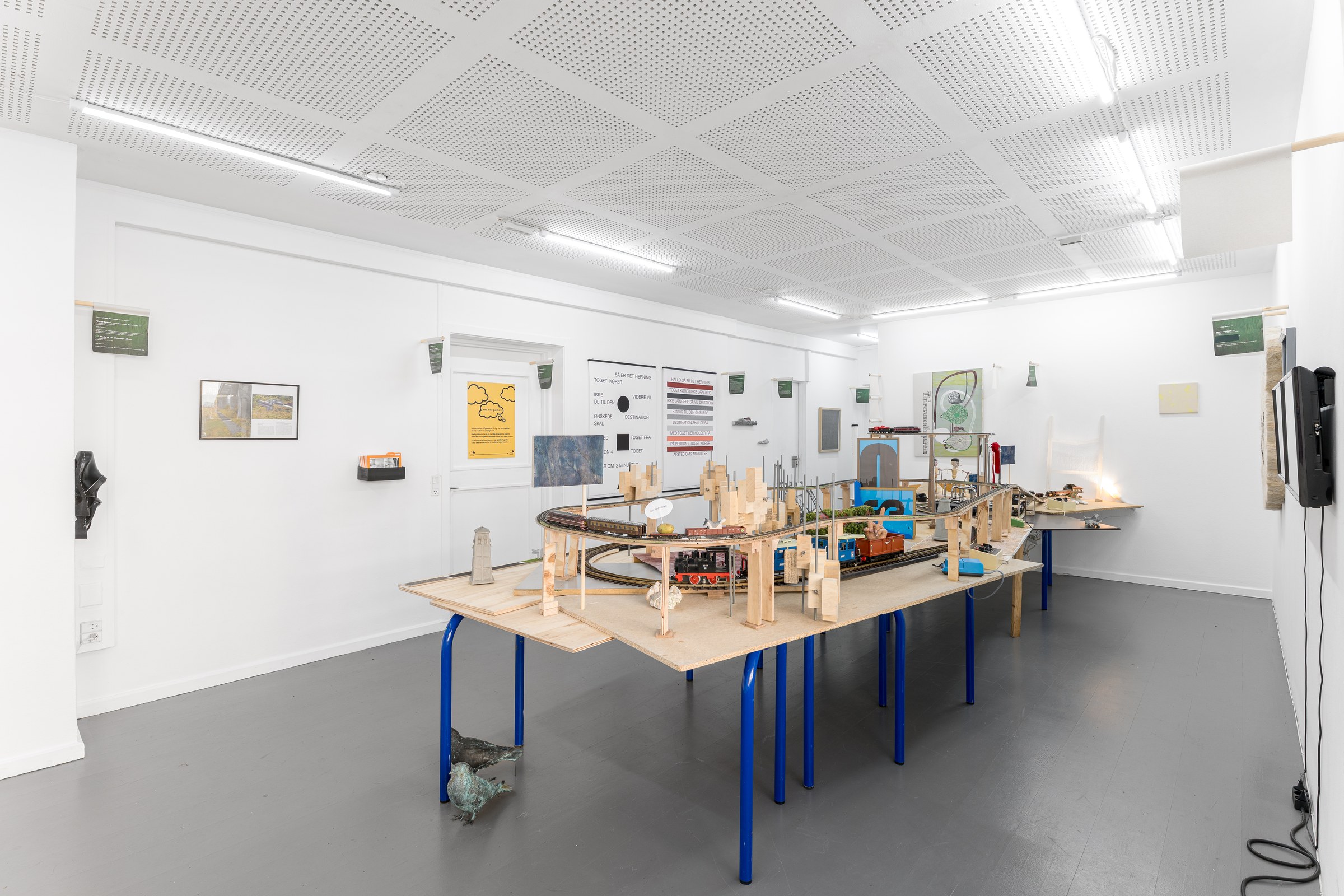
A scale model for the railway. At the centre of the room stands a large diorama where model trains run through a landscape built out of the other artists' works, carrying small pieces with them as they go. In it stands Sydhavn Station as the archive has it in the late years: grown over, a carriage left on the platform above, the letters of the name replaced one at a time in whatever colour was to hand. Nothing in it was modelled by hand. A single generated photograph was passed through an image-to-3D model and printed as it came, with the side the picture showed sharp, the side it never saw guesswork, and the ivy one fused surface rather than leaves. It was painted afterwards. The train passes it like any other station on the line.
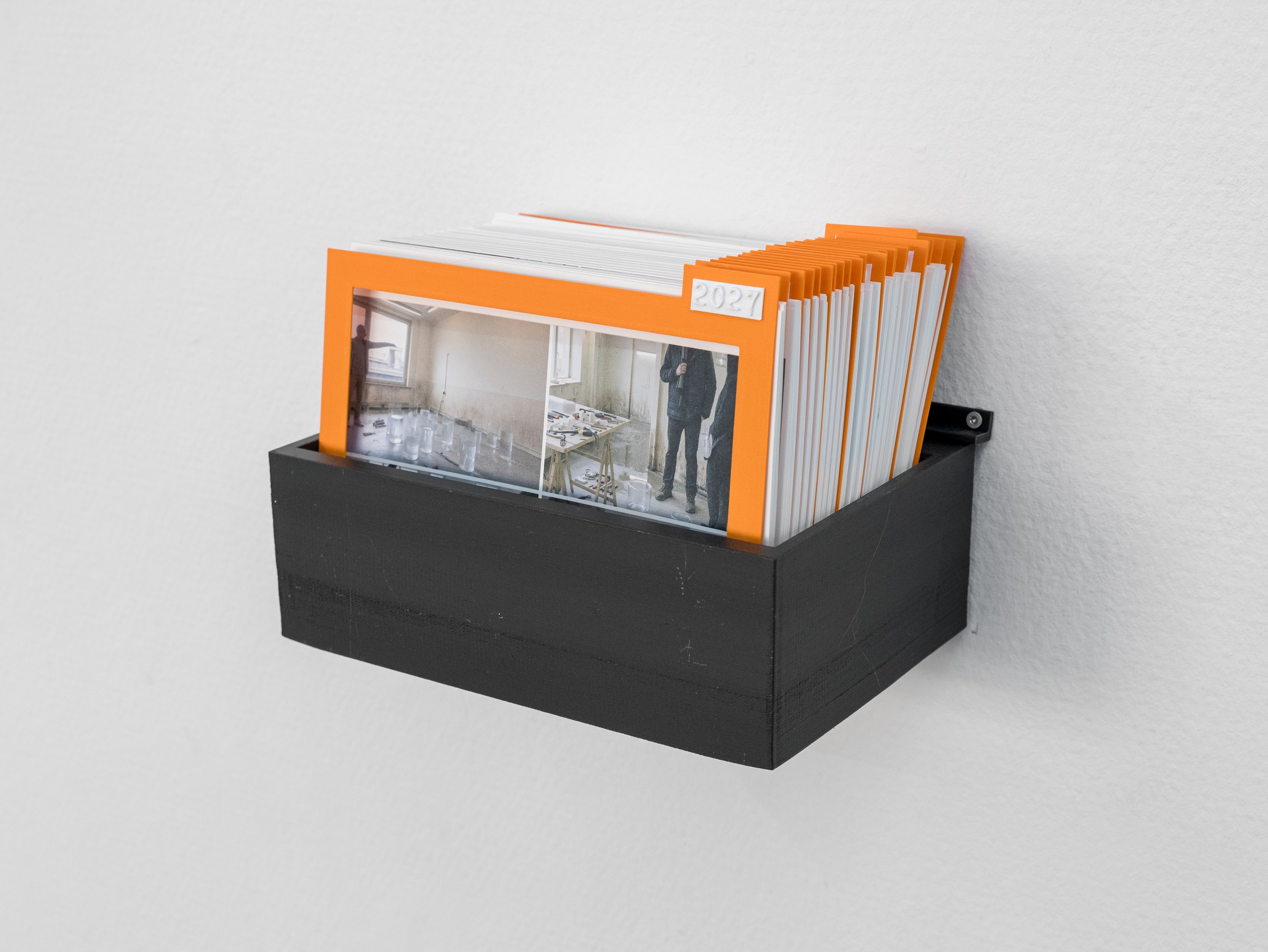
A physical archive. All 214 exhibition cards are printed on heavy stock, A5 landscape, with a photograph glued to each, and filed by year behind orange dividers in a printed container bracketed to the wall. Each divider carries its year in relief, so the twenty-seven years read as a run of tabs. It is the only part of the work that can be handled.
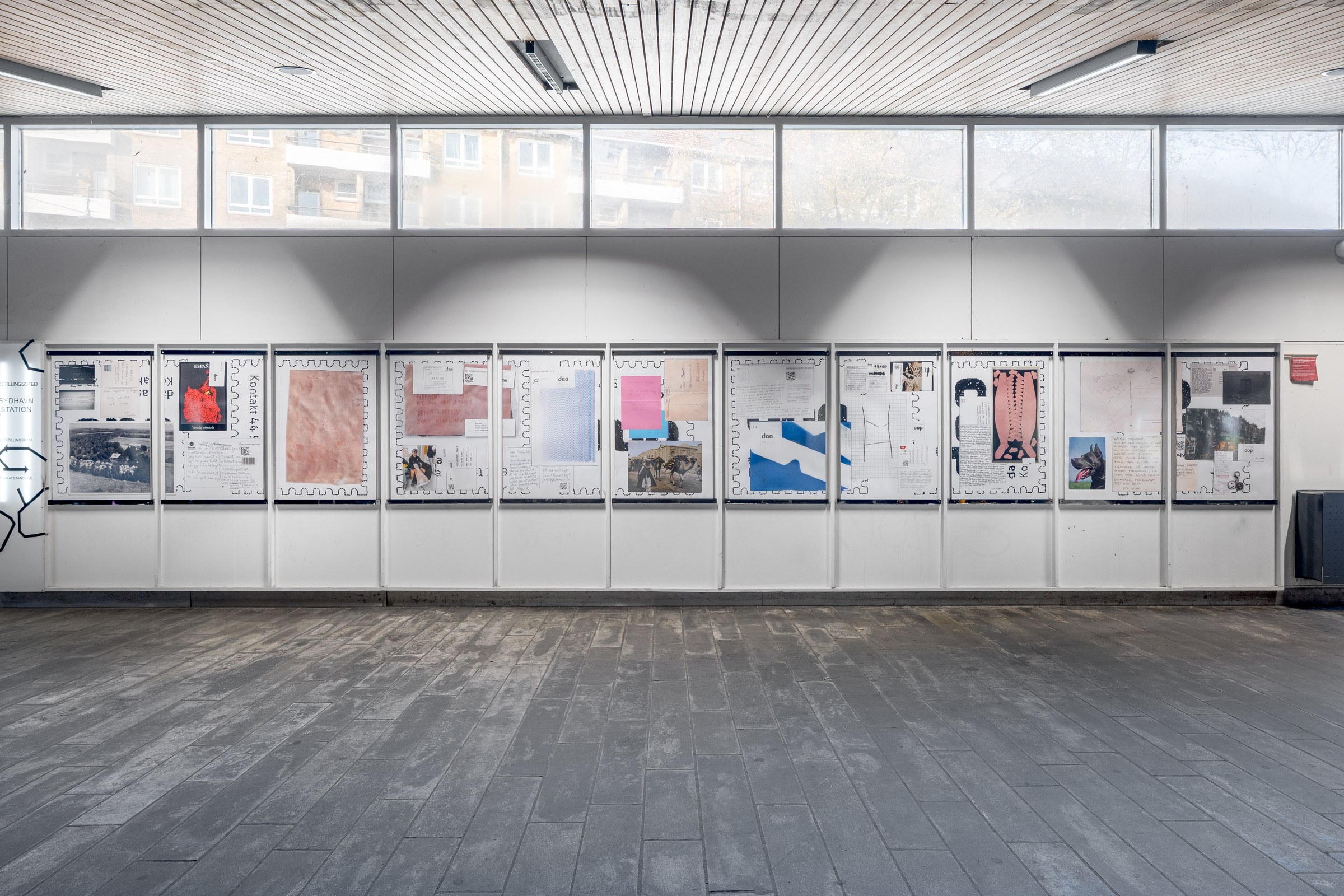
A set of postcards from the future. Over the summer of 2026 the artists in the show posted cards home to the station; some arrived, some came back. They hang as a collage in the old DSB poster frieze and on the billboards outside, under the tracks, as a collective work. Mine are sent from a place that does not exist: the station decades from now, awnings and dancing and animals on the platform, written as though the sender had just got home.
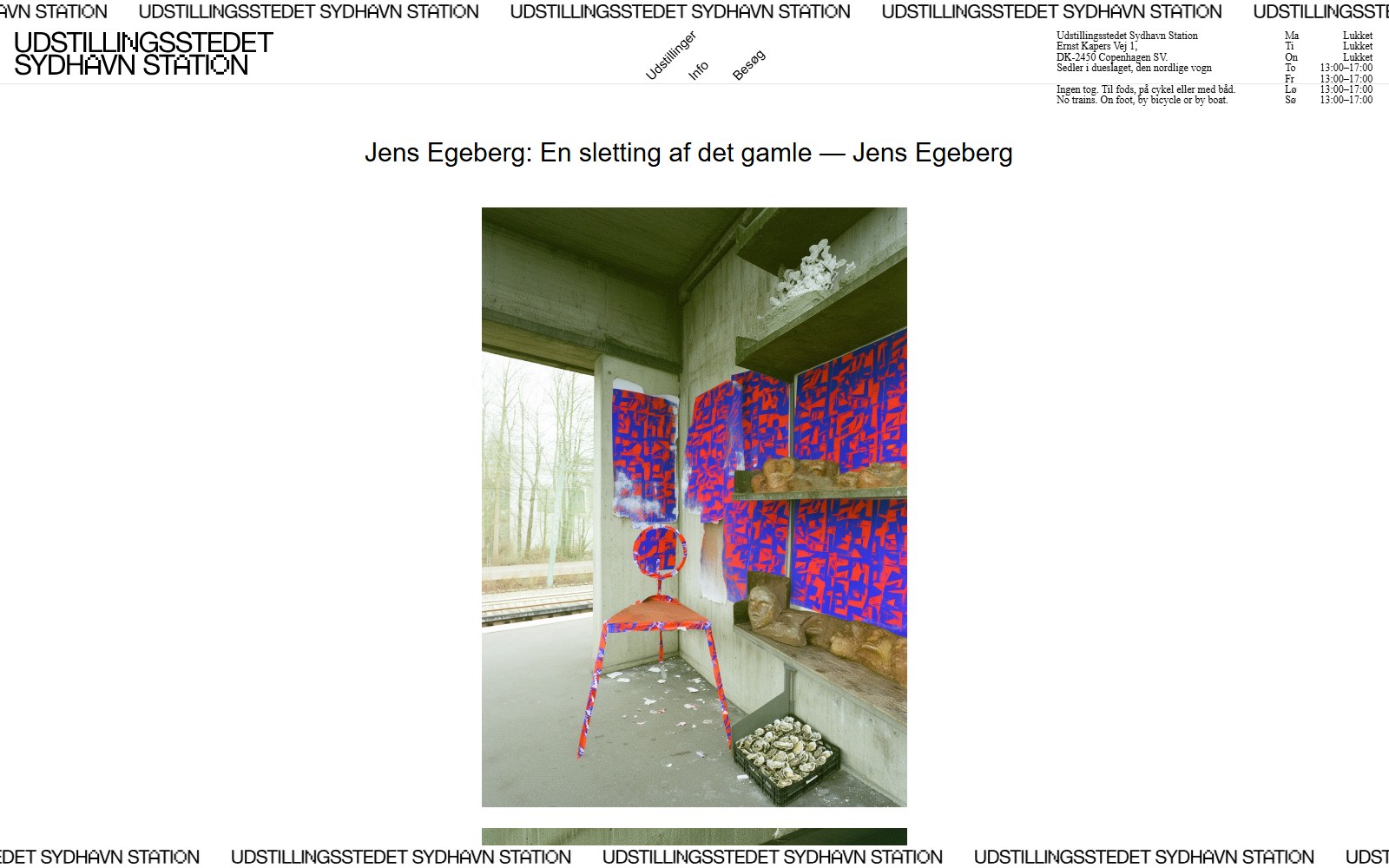
A website, for one month. The whole thing, all 212 invented exhibitions with their texts and photographs, inside a faithful offline copy of the real site so that the two halves sit in the same navigation and nothing announces which is which, was online for exactly as long as the exhibition was up, and came down with it on 15 November 2026. It is kept as an offline archive rather than a live site: a venue's website is a temporary thing, and this one was written to be found and then lost.
Ind med 4 toget was the first exhibition in Copenhagen by Kunstnersammenslutningen Jylland since the association was founded in 1978, and my first since joining. The title is an old Copenhagen insult for someone newly off the train from the provinces, who does not yet know how the city works and can be sold anything. These days you mostly hear it as a question: do you think I came in on the four o'clock train?